When the power goes out, every minute counts. Production stops, systems go dark, and the cost of downtime adds up fast. You’ve invested in an industrial generator to protect your business from exactly this, but a generator can’t help if it doesn’t start when you nehed it. An automatic transfer switch (ATS) detects the outage, signals your generator to start, and shifts your facility from grid power to backup power without anyone lifting a finger.
Without one, someone has to be on-site to notice the outage and switch over manually, which can take minutes or even hours. With one, your lights, equipment, and critical systems keep running, and when utility power returns, the switch moves you back automatically. Keep reading to learn how an ATS works, how it compares to a manual switch, and what to know before you install one with your generator.
Key Takeaways
- An automatic transfer switch (ATS) detects an outage, starts your generator, and shifts your facility to backup power automatically
- The control panel, transfer mechanism, and safety interlocks work together to make the transfer seamless and safe
- An ATS outperforms a manual switch on response time, reliability, and risk of human error
- Healthcare, data centers, manufacturing, and other facilities rely on an ATS to avoid costly downtime
- Sizing, testing, and licensed installation are key to keeping an ATS ready for an outage
Key Components of Automatic Transfer Switches
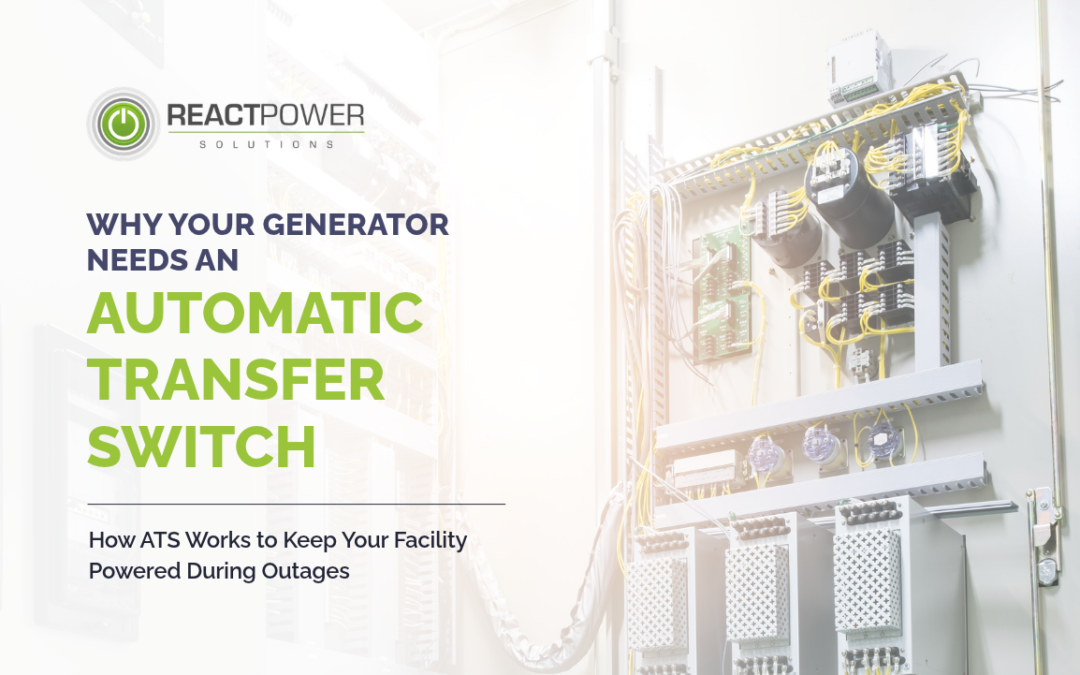
An automatic transfer switch is more than a simple on/off switch. It monitors your power sources and makes split-second decisions to keep your operations running. Here are the key components that make that possible. At the heart of an ATS is the control panel, the brain of the operation. It continuously monitors your utility power, and when it detects a loss, it tells the transfer mechanism to act and signals your generator to start.
The transfer mechanism is the muscle. It physically shifts your electrical load from the utility to the generator when the power fails, and the faster it works, the less time you spend in the dark. The load circuit connects the ATS to your essential systems and equipment, making sure your most important operations stay powered during an outage.
Power source connections link both the utility and the generator to the ATS, allowing the switch to move between them smoothly, whether it’s a routine test or an unexpected outage. Finally, safety interlocks prevent back-feed, which is when generator power flows into the utility grid. This protects utility workers and keeps your equipment from being damaged.
How Automatic Transfer Switches Work
An automatic transfer switch works by constantly watching your utility power and stepping in the moment something goes wrong. When it detects an outage, it starts your backup generator and shifts your facility onto that power without anyone having to intervene. Once the grid is stable again, it moves you back and goes back to watching for the next outage.
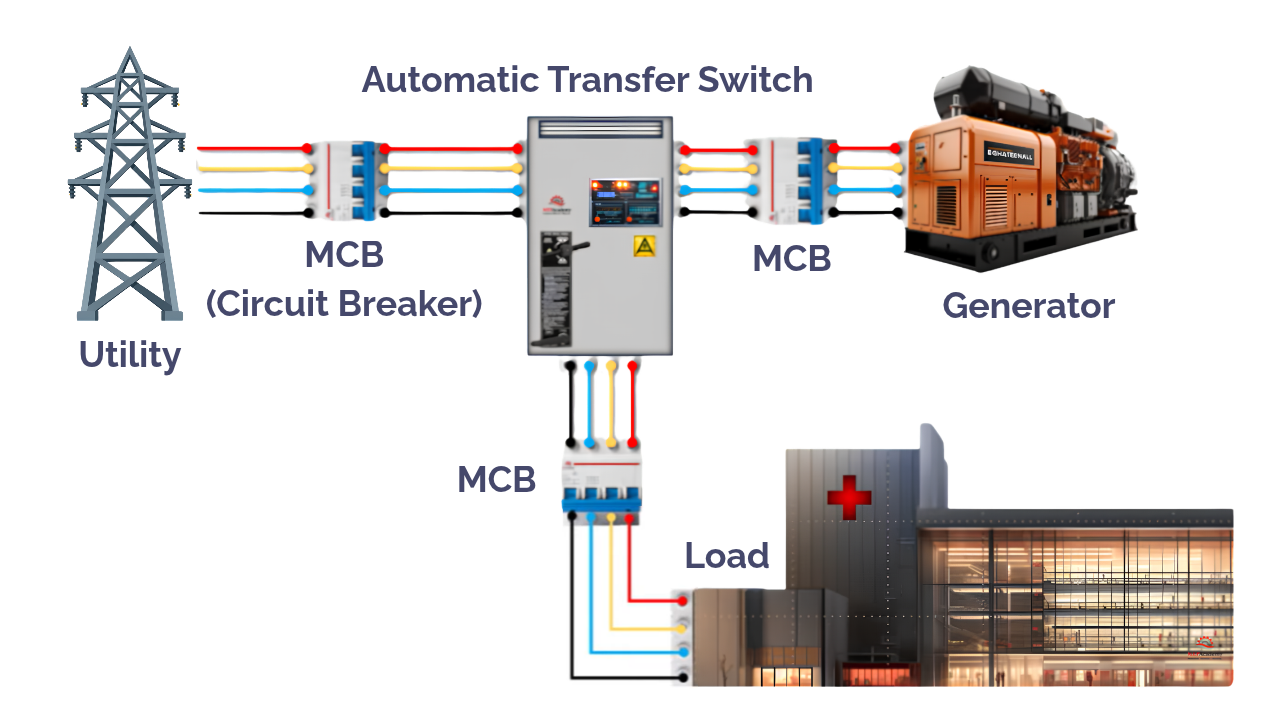
An automatic transfer switch connects utility power and a backup generator to a facility’s electrical load, allowing power sources to switch automatically during an outage.
Here’s how that sequence plays out:
- Monitors utility power: The control panel continuously checks for outages or disturbances in the grid.
- Signals the generator to start: As soon as it detects a power loss, the ATS tells the generator to start up.
- Transfers the load: The transfer mechanism shifts your electrical load from the utility to the generator, so operations continue with minimal interruption.
- Powers essential systems: The generator keeps lighting, data processing, climate control, and other critical systems running until utility power returns.
- Returns to utility power: When the grid stabilizes, the ATS moves the load back to utility power and resumes monitoring.
Reasons Your Generator Needs a Transfer Switch
A generator is only as useful as the way it connects to your facility, and an automatic transfer switch is what makes that connection seamless, safe, and reliable. It removes the need for someone to switch over manually, protects your equipment and utility workers, and keeps your operations running with minimal disruption. Here’s what that means in practice:
- Seamless transitions: An ATS eliminates manual intervention, reducing the risk of human error so operations continue without a hitch.
- Protection from overloads and back-feed: By preventing power from flowing back into the utility grid, it safeguards your equipment and the utility workers on the line.
- Peace of mind: Knowing your essential systems will stay powered lets you focus on running your business instead of worrying about downtime.
- Business continuity: Keeping critical systems operational helps you avoid costly interruptions and maintain productivity.
- Safer, more efficient power management: An ATS streamlines the switch between power sources, lowering the risk of accidents and ensuring a smooth transition every time.
Comparing Automatic vs. Manual Transfer Switches
Choosing between an automatic and a manual transfer switch comes down to how much downtime your business can afford. An automatic switch transfers power immediately without anyone lifting a finger, which makes it the better fit for critical applications. A manual switch costs less upfront, but it needs someone on-site to operate it, which can mean delays, added risk of human error, and costly downtime. Here’s how the two compare:
| Automatic Transfer Switch | Manual Transfer Switch | |
| Response time | Immediate transition with no manual intervention, ideal when every second counts | Delayed, since an operator must physically switch the power source |
| Reliability | Higher reliability for critical applications, with a consistent power supply | Lower reliability, as the transfer depends on someone being available to perform it |
| Staffing needs | Works without anyone on-site, so it suits facilities with limited or no staff | Requires an operator to be present during an outage |
| Risk of human error | Reduced, because the transfer is automated | Higher, which can lead to extended downtime and potential safety hazards |
| Cost | Higher upfront investment | More cost-effective initially, but potentially costly if downtime occurs |
| Best for | Industries where downtime has severe consequences | Facilities with on-site staff and lower-risk operations |
Common Applications for Automatic Transfer Switches
Automatic transfer switches are used across many industries wherever power reliability matters. From hospitals to warehouses, an ATS keeps critical systems running when the grid fails, protecting safety, productivity, and revenue. Here are some of the most common applications:
Healthcare Facilities
Hospitals and clinics rely on an ATS to keep life-saving machines, essential lighting, and other critical equipment running during an outage. That reliability is vital for patient safety and continuous care.
Data Centers
Any interruption in power can mean data loss and costly downtime. An ATS keeps data processing and storage running continuously, helping protect data integrity in tech-dependent environments.
Manufacturing Plants
Even a brief outage can halt a production line, leading to lost revenue and delayed orders. An ATS keeps the power flowing so manufacturing processes stay on track.
Commercial Buildings
Retail stores, offices, and hospitality businesses need reliable power to keep customers satisfied and teams productive. An ATS ensures operations continue smoothly when the grid goes down.
Warehouses
An ATS preserves climate control and security systems, helping maintain proper storage conditions and protect valuable inventory.
Automatic Transfer Switch Questions
How do I choose the right size automatic transfer switch?
An ATS is sized by amperage and voltage, and it needs to match both your generator’s output and your facility’s electrical service. Size it to the load you plan to back up, whether that’s the whole facility or only critical circuits, and leave some room for future growth. A licensed electrician or your generator provider can run the load calculations to get it right.
How often should an ATS be tested and maintained?
Most ATS units should be inspected and tested at least once a year, and many facilities run a test monthly or quarterly alongside their generator exercise schedule. Maintenance typically includes checking connections, cleaning contacts, and verifying the controls work. Healthcare and other regulated facilities may have stricter testing requirements.
How fast does an automatic transfer switch actually work?
The switch itself transfers in a fraction of a second, but the generator needs a few seconds to start and reach stable power first. Many standby systems restore power within about 10 seconds of an outage. If even that brief gap is a problem for sensitive equipment, an uninterruptible power supply (UPS) can bridge it.
What’s the difference between open and closed transition switches?
An open transition switch disconnects from one power source before connecting to the other, which causes a very brief interruption. A closed transition switch briefly overlaps both sources so power never drops during planned transfers, such as routine testing. Closed transition is more complex and costly, so it’s usually reserved for facilities that can’t tolerate any interruption.
Does installing an ATS require a permit or a licensed professional?
In most cases, yes. ATS installation involves your main electrical service, so it typically requires a licensed electrician, a permit, and an inspection under local codes and the National Electrical Code. Your utility may also need to be notified or approve the connection. Working with an experienced generator installer helps make sure everything is compliant from the start.
Keeping Your Facility Powered When the Grid Goes Down
An automatic transfer switch is what turns a backup generator into dependable power protection. Understanding how an ATS works, what its key components do, and how it compares to a manual switch helps businesses make smarter decisions about their backup power and reduce costly downtime.
As an experienced power equipment provider, React Power Solutions helps businesses choose, install, and maintain industrial generator systems. Our team provides power solutions for diesel and natural gas generators, including the equipment that keeps them connected and ready when an outage hits.
Ready to protect your operations from power disruptions? Contact us today to discuss your automatic transfer switch and generator needs in Houston.